


 + 34 604 265 530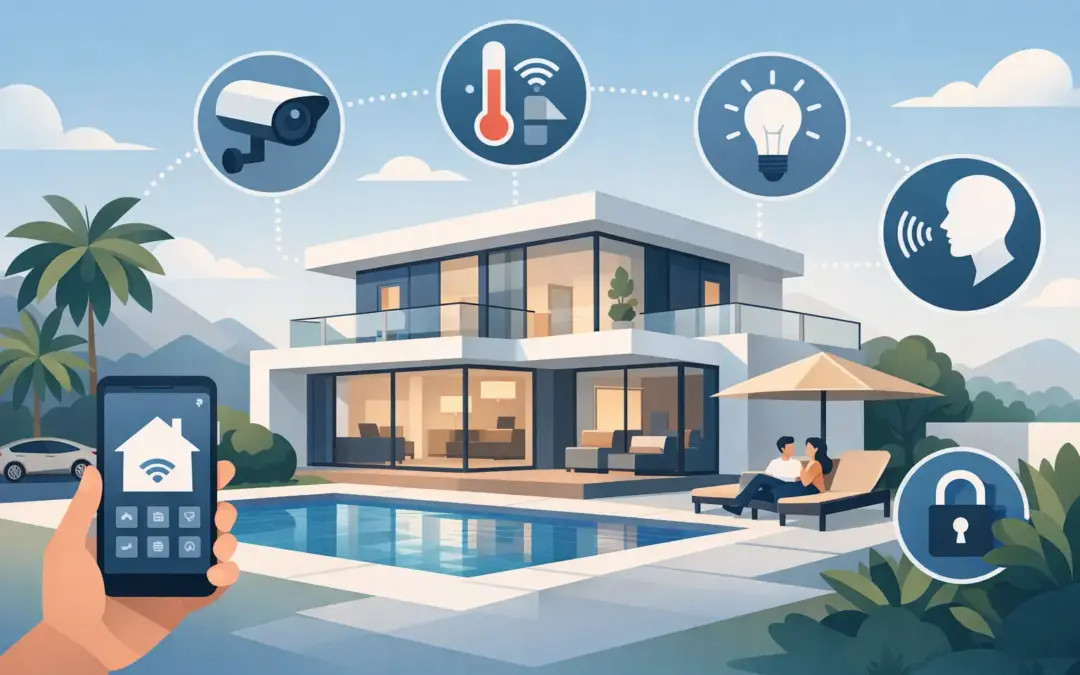
A buyer walks into a contemporary villa, the blinds rise quietly, the climate is already set, exterior cameras are visible but discreet, and the pool can be checked from a mobile phone before the owner boards a flight. That is no longer a novelty feature on the Costa del Sol. At the top end of the market, it is quickly becoming part of the brief.
For lifestyle buyers and investors alike, smart home villas Costa del Sol are appealing for a simple reason: they make premium homes easier to live in, easier to secure and, in many cases, easier to manage from abroad. The key point, however, is that not every "smart" villa is genuinely well specified. Some properties have a few connected devices and little integration. Others are properly planned, with the technology supporting comfort, efficiency, privacy and long-term asset value.
Why smart technology now matters in luxury villas
Costa del Sol ownership often comes with a particular pattern of use. Many owners split their time between Spain and another country. Some visit seasonally. Others place their villa into short-term or medium-term rental when not in residence. In each case, remote visibility matters.
A well-designed smart system allows an owner to monitor entry points, control air conditioning, manage lighting scenes, receive leak alerts and oversee energy consumption without being physically present. In practical terms, that can reduce running costs, protect interiors, and make a large property feel more manageable.
There is also a market expectation issue. In prime locations such as Marbella and Benahavís, buyers looking at new-build or recently refurbished villas increasingly expect integrated lighting, climate zoning, strong connectivity and modern security. A luxury property can still sell without advanced automation, but if the asking price sits at the upper end of the market, outdated systems tend to stand out.
What defines true smart home villas Costa del Sol buyers should consider?
The difference between a gadget-led house and a properly intelligent villa comes down to planning. A premium smart home should feel intuitive rather than technical. Owners should not need to juggle six unrelated apps to run one property.
The strongest villas usually combine core systems into a single control environment. Lighting, heating and cooling, alarm integration, gate access, irrigation, audiovisual settings and sometimes shading or pool functions can all be managed centrally. That matters because fragmented systems become frustrating over time, especially for owners who rely on staff, guests or property managers to use the house correctly.
The best approach also depends on the age of the property. In a new-build villa, smart infrastructure can be built in from the start, with cleaner wiring, hidden hardware and a more cohesive result. In a refurbishment, the priority is often to improve the owner experience without opening up every wall. Wireless and hybrid solutions can work very well, but the ideal specification depends on layout, construction and budget.
The features that add genuine value
Security is usually at the top of the list. For many international owners, the ability to check cameras, receive perimeter alerts, manage gates remotely and confirm the property is secure after departure is one of the most valuable parts of a smart system. In luxury homes, that should be discreetly delivered. Visible protection is reassuring, but over-engineered systems can make a villa feel more commercial than residential.
Climate control is equally important on the Costa del Sol. Villas with strong sun exposure, large glazing and multiple floors benefit from zoned control rather than one blanket setting for the entire property. Smart thermostats and occupancy-based adjustments can improve comfort while avoiding unnecessary energy use. In a second home left empty for periods, this is not just about convenience. It also helps protect finishes, furnishings and wine storage where relevant.
Lighting scenes are another feature buyers notice immediately. Good lighting design changes how a villa feels in the evening, especially in open-plan interiors, terraces and pool areas. Smart control allows owners to shift from daytime practicality to entertaining mode or night-time security with minimal effort. This is one area where quality shows. Poorly planned lighting automation can feel fussy. Well planned scenes feel invisible and polished.
Energy monitoring is becoming more relevant, particularly as buyers become more conscious of operating costs in larger homes. Solar integration, battery storage, EV charging and consumption tracking are increasingly attractive in premium villas. This does not mean every buyer is pursuing a fully off-grid setup. More often, they want lower waste, better oversight and some protection against rising utility costs.
The trade-offs buyers should understand
Smart technology is attractive, but it is not automatically a benefit if it has been installed without long-term thinking. Proprietary systems can be expensive to maintain. Older platforms may become difficult to update. And overly complex setups can be inconvenient for guests or family members who simply want the house to work.
This is why due diligence matters. Buyers should ask who designed the system, whether it can be serviced locally, how easily it integrates with future upgrades, and whether there is manual override for key functions. A villa that depends entirely on one specialist who is hard to reach is less appealing than one with a strong, supportable specification.
There is also a difference between resale value and overcapitalisation. Adding smart features can strengthen a villa's market position, especially in prime locations and contemporary homes. But not every upgrade delivers equal return. Buyers tend to value systems that improve daily use, security and efficiency far more than highly niche automation features that look impressive during a viewing and are rarely used afterwards.
Smart home villas Costa del Sol investors should assess differently
For investors, the right technology package depends on the business model. A pure capital growth buyer may focus on whether the villa remains aligned with premium market expectations over the next five to ten years. In that case, future-proofing, energy efficiency and broad buyer appeal matter most.
For an owner intending to rent the property, the priorities shift slightly. Remote access management, occupancy monitoring, water leak detection, reliable Wi-Fi coverage and simplified guest controls become especially important. Holiday lets do not benefit from systems that require a detailed handover every time a guest arrives. They benefit from technology that supports easy check-in, reduces avoidable call-outs and helps the property remain in excellent condition between stays.
This is where an end-to-end operator has a genuine advantage. Sourcing a villa is one part of the process. Assessing whether the property's infrastructure suits rental, refurbishment or long-term ownership is another. Through https://mw-estates.com, buyers can approach the Costa del Sol market with a clearer view of how acquisition, upgrading and ongoing management fit together.
Location still shapes the specification
Not every area demands the same smart-home brief. In established villa neighbourhoods, security and perimeter control may be the first concern. In newer contemporary developments, buyers often expect integrated home automation as standard. In hillside settings, solar performance, connectivity strength and remote management may carry more weight. In busy lifestyle locations near Puerto Banús or Marbella's Golden Mile, owners may focus more on convenience, privacy and lock-up-and-leave practicality.
That means the right specification is always contextual. A frontline golf villa used for extended family holidays may prioritise entertainment systems and outdoor lighting. A modern investment property may benefit more from energy management and simplified remote oversight. The technology should fit the ownership pattern, not the other way round.
What to ask before buying
When viewing a smart villa, buyers should look beyond the demonstration. Ask whether the automation covers the whole house or only selected rooms. Check how many systems sit within one platform. Review internet backup options, because smart homes are only as dependable as their connectivity. Confirm whether there is ongoing support after completion, especially if the villa will be left vacant for periods.
It is equally sensible to ask about refurbishment potential. If a property is strong in location and layout but weak in technology, that is not necessarily a reason to dismiss it. In many cases, a well-located villa can be significantly improved with a considered smart-home upgrade as part of a broader modernisation plan. The key is understanding the cost, disruption and likely impact on future value before committing.
The most desirable villas on the Costa del Sol are no longer defined by architecture alone. Buyers still care about sea views, privacy, finish and address, but they also want homes that respond well to modern ownership. Smart systems, when properly specified, support that expectation rather than distract from it.
For serious buyers, the smartest question is not whether a villa has technology. It is whether the technology makes the property more secure, more efficient and more enjoyable to own for years to come.